

Arrival at Tribhuwan International Airport. Our Staff member meets you and transfers you to the hotel.
Overnight stay at a hotel.
Everest Region

Trek Starting Point
Lukla

Trek Ending Point
Lukla

Departure From
Ramechhap

Transportation
Domestic flight

Style
High-altitude trekking & peak climbing

Meal
Breakfast, Lunch, Dinner

Accommodation
Tourist standard hotel in Kathmandu, Teahouse during trek
The Lobuche East Peak Climbing with Everest Base Camp Trek is a thrilling Himalayan expedition that combines the world-famous Everest Base Camp adventure with the challenge of summiting Lobuche East Peak (6,090 m). Located in the heart of the Khumbu region, this journey offers the perfect blend of classic Everest trekking, Sherpa culture, dramatic mountain landscapes, and the excitement of climbing a true Himalayan summit.
The adventure begins with a scenic flight to Lukla before entering the spectacular Khumbu Valley, where ancient monasteries, traditional Sherpa villages, and breathtaking Himalayan scenery create an unforgettable trekking experience. As the trail climbs higher toward the Everest region, trekkers enjoy magnificent views of Mount Everest, Lhotse, Nuptse, Ama Dablam, Pumori, and numerous other snow-covered peaks.
Reaching Everest Base Camp and the iconic Kala Patthar viewpoint is one of the major highlights of the journey, providing incredible close-up views of Everest and the surrounding Himalayan giants. From here, the adventure moves beyond traditional trekking as the route heads toward the Lobuche region, where preparation begins for the ascent of Lobuche East Base Camp and High Camp.
The summit climb of Lobuche East Peak is a challenging and rewarding mountaineering experience, involving glacier crossings, fixed rope sections, steep snow slopes, and high-altitude climbing techniques. Standing at the summit of Lobuche East at 6,090 m, climbers are rewarded with breathtaking panoramic views of some of the world's highest mountains and a profound sense of accomplishment.
Alongside the physical challenge, the expedition offers a deep cultural connection with the Sherpa people and their Himalayan way of life. The region's monasteries, prayer flags, mountain villages, and traditions add a meaningful dimension to the adventure.
Designed for passionate trekkers and aspiring mountaineers, the Lobuche East Peak Climbing with Everest Base Camp Trek is an ideal Himalayan challenge for those seeking to experience the beauty of Everest while achieving the satisfaction of standing on a 6,000-meter summit.
Arrival at Tribhuwan International Airport. Our Staff member meets you and transfers you to the hotel.
Overnight stay at a hotel.
After breakfast at the hotel, our guide will meet you at the hotel and provide a briefing about the upcoming trek, including the itinerary, safety information, and important preparations. He will also assist you with all the necessary trekking formalities and paperwork.
After the briefing, we will go on a sightseeing tour around the Kathmandu Valley, visiting famous UNESCO World Heritage Sites such as Boudhanath Stupa, one of the largest Buddhist stupas in the world, and Swayambhunath Stupa, also known as the Monkey Temple. On this day, we will also arrange the TIMS card and other required permits for the trek.In the evening, you will have time to prepare your trekking gear and make the final arrangements for the journey ahead. Overnight stay at a hotel.
After an early breakfast, we will fly from Kathmandu (1,400 m / 4,600 ft) to Lukla (2,840 m / 9,317 ft). The short 35-minute flight offers spectacular views of the Himalayas, and landing on the hillside airstrip is an adventure in itself, with mountains towering on all sides and a steep drop at the end of the runway. The crisp mountain air and dramatic landscapes make it clear that we have entered the heart of the Everest region.
From Lukla, we will start our trek along a gentle trail towards Cheplung Village, enjoying the striking views of Mount Khumbila. The path then gradually descends through the Dudh Koshi River valley as we make our way to Phakding (2,610 m / 8,563 ft). Surrounded by lush hills and offering panoramic views of Kusum Kanguru, Phakding is a charming village with comfortable lodges that serve trekkers. The trek from Lukla to Phakding is approximately 8 km (5 miles) and takes around 3–4 hours, providing a relaxed start to acclimatize and soak in the Himalayan scenery. Overnight at a guesthouse in Phakding.
Note: The weather in Lukla is highly unpredictable. Occasionally, flights may be delayed or canceled due to adverse weather conditions. If a flight is canceled, you will need to return to your hotel in Kathmandu. Please note that transportation back to the hotel and accommodation for this night are not included. If the weather clears the next day, you will be accommodated on either the 3rd or 4th flight to Lukla. If conditions remain unfavorable, there is also an option to take a helicopter flight. The cost of a helicopter flight is not fixed and will be quoted by the airline on the same day. You should expect to pay an additional approx. 250 USD for the helicopter transfer from Kathmandu to Lukla. Although such situations are rare, we believe it is important to inform you in advance.
We will start our trek from Phakding (2,610 m / 8,563 ft) and follow the trail along the Dudh Koshi River, passing through traditional Sherpa villages and suspension bridges. The trail gradually ascends through pine and rhododendron forests, offering beautiful views of the surrounding hills and mountains. We will cross several small settlements before reaching Monjo (2,835 m / 9,301 ft), where we may stop for a short break.Continuing uphill, we will climb steeply to Namche Bazaar (3,440 m / 11,286 ft), the main trading hub of the Khumbu region. The trek covers approximately 10 – 12 km and takes around 5–7 hours, making it a moderate to challenging day that helps with acclimatization. Along the way, we will enjoy panoramic views of Thamserku and Kongde Ri, and take in the lively atmosphere of Namche Bazaar, surrounded by dramatic Himalayan peaks. Overnight at a guesthouse in Namche Bazaar.
We will begin our trek from Namche Bazaar (3,440 m / 11,286 ft), leaving behind the lively Sherpa town as we follow a gently ascending trail along the hillside above the Dudh Koshi Valley. The path offers a comfortable and scenic walk, with unfolding views of iconic Himalayan peaks such as Ama Dablam (6,812 m / 22,349 ft) and Thamserku (6,623 m / 21,729 ft). Passing through Syangboche (3,780 m / 12,402 ft), the landscape opens into wide yak pastures and quiet highland terrain.
After approximately 2–3 hours of trekking, covering around 3.5–4.5 km (2.2–2.8 miles), we will arrive at Khumjung(3,790 m / 12,434 ft), a serene Sherpa village nestled beneath the sacred peak of Khumbila (5,761 m / 18,901 ft). Here, we will have time to explore the village and take in the peaceful mountain atmosphere. Overnight at a guesthouse in Khumjung.
We will begin our trek from Khumjung (3,790 m / 12,434 ft), descending through quiet Sherpa villages and rejoining the main Everest trail near Namche Bazaar. The path then contours along the mountainside, offering breathtaking views of Ama Dablam (6,812 m / 22,349 ft) and Lhotse (8,516 m / 27,940 ft).
Continuing onward, we descend to Phunki Tenga (3,250 m / 10,663 ft) before a steady climb through forest to Tengboche(3,860 m / 12,664 ft), home to its renowned monastery. From here, the trail descends and gradually ascends along the Imja Valley.
After approximately 5–7 hours of trekking, covering around 10–12 km (6.2–7.5 miles), we will arrive at Pangboche(3,985 m / 13,074 ft), a traditional village set beneath the towering Ama Dablam, where we can relax and take in the alpine surroundings. Overnight at a guesthouse in Pangboche.
We will begin our trek from Pangboche (3,985 m / 13,074 ft), following a gradual ascent along the Imja Valley as the landscape becomes more open and alpine. The trail climbs steadily above the tree line, offering close-up views of Ama Dablam (6,812 m / 22,349 ft) and surrounding Himalayan peaks, while passing through scattered yak pastures and small seasonal settlements.
Continuing along a gentle but steady incline, we cross a bridge and move through the windswept terrain of Somare (4,010 m / 13,156 ft), before the valley widens into a broad, glacial landscape. The climb remains manageable, making it an important acclimatization day as we gain altitude gradually.
After approximately 3–4 hours of trekking, covering around 5–6 km (3.1–3.7 miles), we will arrive at Dingboche (4,410 m / 14,469 ft), a scenic village surrounded by stone-walled fields beneath towering peaks. Upon arrival, we can rest and take in the expansive mountain views. Overnight at a guesthouse in Dingboche.
This day is set aside for acclimatization in Dingboche (4,410 m / 14,469 ft), giving our bodies time to adapt to the higher altitude while staying gently active. Rather than remaining idle, we will take a short hike above the village to support the acclimatization process and enjoy expansive Himalayan views.
A recommended ascent is toward Nagarjun Hill (approximately 5,000 m / 16,404 ft), rising above Dingboche. The climb is gradual but noticeably more demanding due to the altitude, rewarding us with sweeping panoramas of Ama Dablam, Lhotse, Makalu, and the surrounding Himalayan range. After spending time at the viewpoint, we descend back to the village.
The excursion takes around 3–4 hours round trip, covering approximately 3–4 km (1.8–2.5 miles). The remainder of the day is free for rest, exploration, and preparation for higher elevations. Overnight at a guesthouse in Dingboche.
We will begin our trek from Dingboche (4,410 m / 14,469 ft), leaving behind the broad alpine valley as we gradually gain altitude into a more rugged and glacial landscape. The trail climbs steadily, with views opening toward Ama Dablam(6,812 m / 22,349 ft) before the terrain becomes increasingly barren and windswept. Continuing onward, we reach Thukla (4,620 m / 15,157 ft), where a steep ascent leads to the memorial ridge honoring climbers who have lost their lives in the Himalayas. From this point, the trail levels into a dramatic high-altitude traverse with striking views of Lhotse (8,516 m / 27,940 ft), Pumori (7,161 m / 23,494 ft), and surrounding peaks. After approximately 5–6 hours of trekking, covering around 7–8 km (4.3–5 miles), we will arrive at Lobuche (4,910 m / 16,108 ft), a remote high-altitude settlement set against the stark beauty of the Khumbu Glacier. Overnight at a guesthouse in Lobuche.
We will begin our trek from Lobuche (4,940 m / 16,207 ft), following the trail along the rugged moraine of the Khumbu Glacier toward Gorakshep (5,164 m / 16,942 ft), the last settlement before Everest Base Camp. The trail gradually ascends through rocky terrain, offering impressive views of surrounding Himalayan peaks such as Nuptse, Pumori, and Lingtren.
After a short rest at Gorakshep, we will continue our trek toward the legendary Everest Base Camp (5,364 m / 17,598 ft). The path follows the edge of the glacier, crossing rocky moraines and glacial terrain while providing close-up views of the dramatic Khumbu Icefall. Upon reaching Everest Base Camp, we will take time to enjoy the incredible atmosphere of the world’s highest mountain, capture photographs, and admire the surrounding Himalayan landscape. After spending some time at Base Camp, we will retrace our steps back to Gorakshep for the night.
After approximately 7 – 8 hours of trekking, covering around 14 –15 km (8.5–9 miles) round trip, we will return to Gorakshep to rest and prepare for the next day’s adventure. Overnight at a guesthouse in Gorakshep.
We will begin the pre-dawn ascent from Gorakshep (5,164 m / 16,942 ft), heading steadily uphill toward the iconic viewpoint of Kala Patthar (5,545 m / 18,192 ft). The trail is short but steep, climbing a rugged, rocky ridge where the altitude makes each step more demanding. As we gain height, the panorama unfolds spectacularly, offering breathtaking close-up views of Mount Everest (8,848.86 m / 29,031 ft), along with Lhotse (8,516 m / 27,940 ft) and Nuptse (7,861 m / 25,791 ft), glowing in the early morning light.
After approximately 2 – 3 hours round trip, covering around 3 km (1.9 miles), we descend back to Gorakshep for breakfast and a short rest. From here, we begin the trek toward Lobuche (4,950 m / 16,240 ft), retracing the trail across glacial moraine and open alpine terrain. The gradual descent brings a slight increase in oxygen, making the walk more comfortable as the dramatic Himalayan landscape stretches around us.
Following a 2 – 3 hour trek from Gorakshep, covering around 4 – 5 km (2.5 – 3.1 miles), we arrive at Lobuche, a small high-altitude settlement nestled beneath towering peaks. The remainder of the day is free to rest and recover after the early climb, with time to take in views of surrounding mountains such as Pumori (7,161 m / 23,494 ft).
Overnight at a guesthouse in Lobuche.
We will begin our trek from Lobuche (4,910 m / 16,108 ft), leaving the main Everest Base Camp trail and heading toward the quieter, more rugged route leading to Lobuche East High Camp (approx. 5,400 m / 17,716 ft). The trail starts with a gradual ascent over rocky terrain before becoming steeper as we gain elevation, following glacial moraine and alpine slopes.
As we climb higher, the surroundings grow more remote and dramatic, with impressive views of Lobuche East (6,119 m / 20,075 ft) and neighboring Himalayan peaks. The high altitude makes the trek more demanding, so a slow and steady pace is essential.
The trek typically takes around 3 – 5 hours, covering approximately 3 – 4 km (1.9 – 2.5 miles). Upon reaching High Camp, we settle into a basic tented camp set on a rocky slope with panoramic mountain views. The remainder of the day is spent resting, hydrating, and preparing for the summit climb.
Overnight at tented camp in Lobuche High Camp.
We will begin the summit push before dawn from Lobuche East High Camp (5,400 m / 17,716 ft), setting out in cold, dark conditions with headlamps guiding the way. The trail immediately climbs steeply over rocky terrain before transitioning onto glacier slopes, where fixed ropes and crampons are used as we move into more technical ground.
As we gain altitude, the landscape opens into a vast alpine world of ice and snow, with the surrounding peaks slowly revealing themselves in the early light. The final ascent is steady but demanding due to the thin air and steep incline.
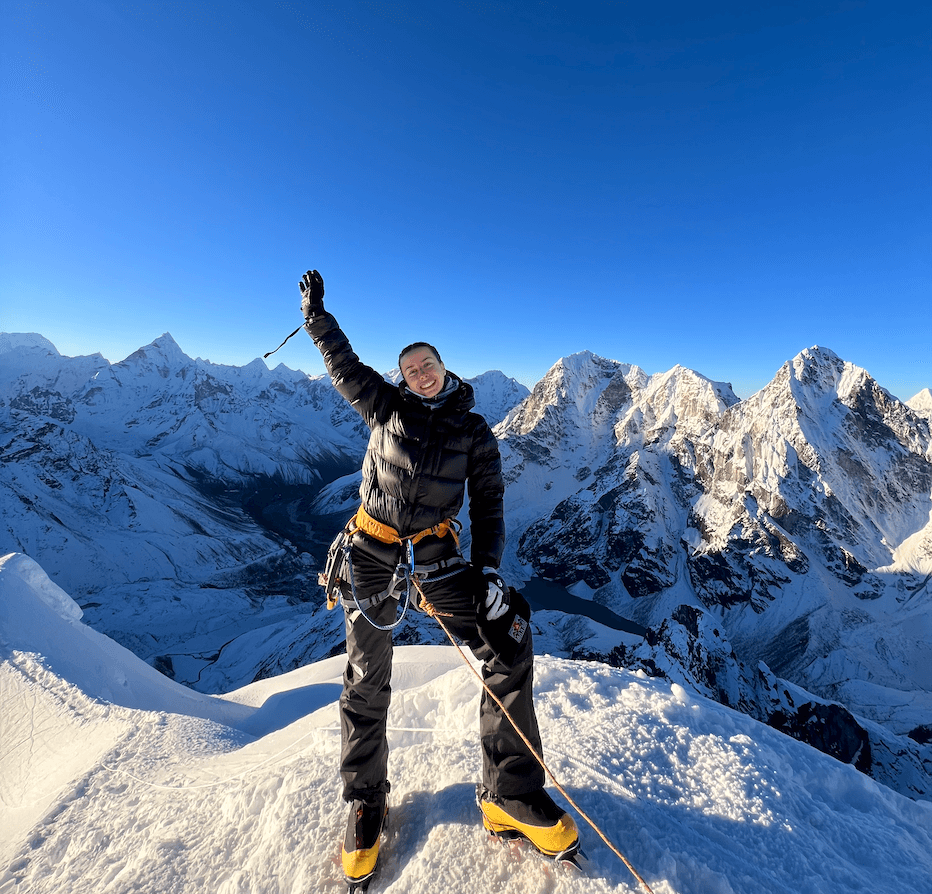
After approximately 2.5–3.5 km (1.5 – 2.2 miles) of climbing over several hours, we reach the summit of Lobuche East(6,090 m / 19,980 ft). From the top, we are rewarded with sweeping views of the Khumbu Himal, including Mount Everest (8,848.86 m / 29,031 ft), Lhotse (8,516 m / 27,940 ft), and Nuptse (7,861 m / 25,791 ft).
After spending a short but unforgettable moment at the summit for rest, photographs, and reflection, we begin our careful descent. The return journey demands full concentration as we retrace the same technical sections, down-climbing from snow to rock, and finally back across the moraine toward High Camp.
By the time we return to Lobuche East High Camp, the effort of the day settles in, and we arrive back into the safety of camp after a total round trip of approximately 4–6 km (2.5–3.7 miles) and 8 –10 hours of climbing.
We spend the remainder of the day resting at High Camp, surrounded once again by the silent grandeur of the high Himalayas.
We will begin our descent from Lobuche East High Camp (5,400 m / 17,716 ft), leaving behind the exposed high-altitude slopes and retracing our route down through rocky and glacial terrain. The early section is steep and requires careful footing as we descend from the alpine zone back toward more stable ground.
Gradually, the landscape softens as we return to Lobuche (4,910 m / 16,108 ft), where the vast moraine opens into familiar trekking trails. From here, we continue our steady descent through the Khumbu valley, passing Thukla (4,620 m / 15,157 ft) and the memorial ridge, where the mountains feel quieter and more grounded after the heights above.
The trail then flows downward toward Pheriche (4,240 m / 13,911 ft), where the air grows noticeably thicker and walking becomes easier with every step. The valley widens, and the harsh alpine terrain slowly gives way to softer, greener tones of the lower Himalayas.
From Pheriche, we continue the final stretch to Pangboche (3,985 m / 13,074 ft), one of the oldest Sherpa villages in the region, marked by ancient monasteries and traditional stone homes. We arrive in Pangboche by late afternoon, completing a long and rewarding descent from the high Himalayas. Overnight at a guesthouse in Pangboche.
We will begin our descent from Pangboche (3,985 m / 13,074 ft), leaving behind the quiet stone village and its ancient monastery. The trail starts with a gentle walk through open hillside before gradually entering forested terrain as we lose altitude.
As we continue downward, the route passes through small settlements and rhododendron and pine forests. The air feels noticeably thicker, and the landscape becomes greener and more alive with every step. We follow the valley alongside the Dudh Koshi River, crossing suspension bridges and passing familiar trekking villages along the way.
From there, the trail begins a steady climb back up toward Namche Bazaar (3,440 m / 11,286 ft), the main trading hub of the Khumbu region. The final ascent into Namche is gradual but steady, marking our return to a lively mountain town after days in remote high-altitude terrain. We arrive in Namche Bazaar by afternoon, where the energy of the town feels like a welcome contrast to the quiet trails behind us. Overnight at a guesthouse in Namche Bazaar.
We will begin our descent from Namche Bazaar (3,440 m / 11,286 ft), leaving behind the lively mountain town that once marked our entry into the Khumbu. The trail drops steeply at first through stone steps and pine forests, leading us back into the Dudh Koshi valley.
As we continue, we pass through familiar villages like Monjo and Phakding, where the landscape gradually softens and the air becomes warmer and richer. Rivers, suspension bridges, and green hills slowly replace the high alpine scenery of the Lobuche Peak region.
This final walk feels like a quiet transition after the high-altitude adventure of Lobuche East (6,090 m / 19,980 ft), bringing us step by step back toward lower elevations and everyday life.
The trail then makes a steady climb back up to Lukla (2,860 m / 9,383 ft), where the journey first began. The approach into Lukla feels reflective, as the mountains slowly fade behind us. Overnight at a guesthouse in Lukla.
After completing the Lobuche Peak Climbing, we will take an early morning flight from Lukla (2,860 m / 9,383 ft) back to Kathmandu (1,400 m / 4,593 ft). The short flight of about 30 – 40 minutes offers spectacular aerial views of the Himalayan peaks, glaciers, and deep river valleys, providing one last chance to admire the grandeur of the Everest region from above.
Upon arrival in Kathmandu, you will be transferred to your hotel. The remainder of the day can be spent relaxing, exploring the city, or shopping for souvenirs after your high-altitude adventure.Overnight at a hotel in Kathmandu.
Today marks the end of your Lobuche Peak Expedition. Depending on your flight schedule, you will be transferred from your hotel in Kathmandu (1,400 m / 4,593 ft) to Tribhuvan International Airport for your onward journey. This is the perfect time to reflect on the incredible experiences, breathtaking Himalayan scenery, and cultural encounters you have enjoyed throughout your trek. Safe travels and fond memories accompany you as you depart from Nepal.